


Supportive Housing that Creates Stability
NeighborWorks Alaska’s Supportive Housing Department helps individuals and families move out of homelessness and into safe, stable homes. Through federal U.S. Department of Housing and Urban Development (HUD) and State-funded programs, we provide rental assistance and supportive services for people experiencing chronic and literal homelessness, including individuals living with disabilities.
Our approach is client-centered and rooted in dignity, choice, and respect. Support services are voluntary and tailored to each participant’s goals and needs, recognizing that stability looks different for everyone.
By combining housing assistance with ongoing case management, we support participants in building stability, improving well-being, and creating pathways toward long-term success.
We offer various programs, ensuring people receive the right level of support at the right time — whether that means long-term assistance or short-term stabilization on the path toward independence.
Who We Serve
NeighborWorks Alaska Supportive Housing serves individuals and families who meet the federal HUD definition of homelessness and are seeking support to obtain or maintain stable housing.
Our programs primarily serve people experiencing literal homelessness, including individuals living in places not meant for human habitation, emergency shelters, or safe havens. Many of the households we serve face significant barriers to housing stability, such as long-term or repeated episodes of homelessness, disabilities, behavioral health needs, substance use disorders, chronic health conditions, or other circumstances that make securing housing without support difficult.
Depending on the program, services may be short-term or long-term. Some participants benefit from ongoing supportive services paired with permanent housing, while others receive time-limited assistance designed to help them stabilize quickly and move toward independence. Program eligibility and prioritization are guided by HUD regulations and local system standards.
How to Access Services
NeighborWorks Alaska Supportive Housing programs are accessed through the community’s Coordinated Entry (CE) System, as required by HUD. Coordinated Entry provides a standardized and equitable process for assessing individuals and families experiencing homelessness and prioritizing them for housing resources based on vulnerability, length of homelessness, and housing needs.
To be considered for housing assistance, individuals must complete a Coordinated Entry assessment through an approved access point or partner agency. This assessment helps determine eligibility for different housing interventions, such as Permanent Supportive Housing or Rapid Rehousing, based on HUD criteria and local prioritization policies.
Referrals to NeighborWorks Alaska programs are made through Coordinated Entry as housing becomes available. NeighborWorks Alaska does not accept walk-in or self-referrals for HUD-funded housing programs outside of this process.
If you are unsure whether you or someone you support may be eligible, a Coordinated Entry access point can provide guidance, answer questions, and help determine next steps.
Learn more about Coordinated Entry: https://www.aceh.org/coordinated-entry
Frequently Asked Questions
Under federal guidelines, a person is considered literally homeless if they are:
- Sleeping in a place not meant for human habitation (such as a vehicle, tent, or outdoors), or
- Staying in an emergency shelter or safe haven
People staying temporarily with friends or family (“couch surfing”) may not always meet this definition, but are encouraged to complete a Coordinated Entry assessment to explore available options.
Chronic homelessness is a federal designation used to prioritize housing for people with the highest needs. It generally refers to an individual (or head of household) who:
- Has experienced homelessness for 12 consecutive months or more, or
- Has had multiple episodes of homelessness over at least three years totaling 12 months or more, and
- Has a disabling condition, such as a physical disability, mental health condition, substance use disorder, or chronic health condition
This designation is used primarily to determine eligibility for Permanent Supportive Housing.
To be considered for housing assistance, individuals must complete a Coordinated Entry assessment through an approved access point or partner agency. This assessment helps determine eligibility for different housing interventions, such as Permanent Supportive Housing or Rapid Rehousing, based on federal HUD criteria and local prioritization policies.
Referrals to NeighborWorks Alaska programs are made through Coordinated Entry as housing becomes available. NeighborWorks Alaska does not accept walk-in or self-referrals for HUD-funded housing programs outside of this process.
If you are unsure whether you or someone you support may be eligible, a Coordinated Entry access point can provide guidance, answer questions, and help determine next steps.
Learn more about Coordinated Entry: https://www.aceh.org/coordinated-entry
Coordinated Entry (CE) is a federal HUD-required system that helps communities ensure housing resources are accessed and prioritized fairly. Instead of applying to individual housing programs, people complete one assessment that helps match them to appropriate housing options based on need, vulnerability, and eligibility.
Coordinated Entry helps reduce barriers, avoid duplication, and ensure limited housing resources are directed to those with the greatest need.
No. Federal HUD-funded supportive housing programs do not require income, employment, sobriety, or participation in treatment to be eligible for housing. Supportive services are voluntary and designed to help individuals maintain stability once housed.
Federal HUD requires housing programs to accept referrals through the Coordinated Entry System to ensure equitable access across the community. While NeighborWorks Alaska provides housing and services, referrals must come through Coordinated Entry rather than direct application.
Current Snapshot of Supportive Housing
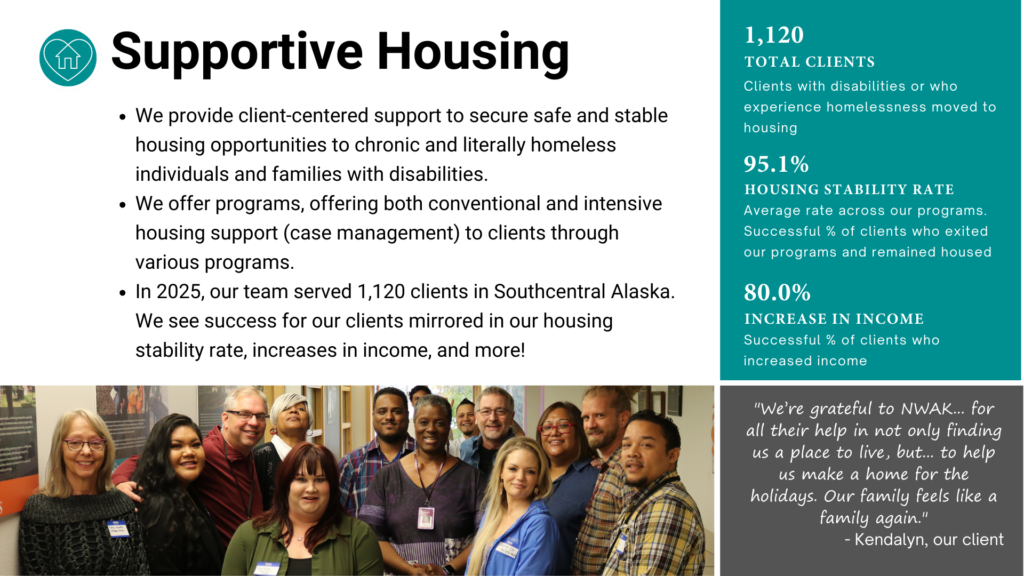
*Data from 2025 Supportive Housing Programs
Ready to Get Started?
If you or someone you know may be eligible for NeighborWorks Alaska’s Permanent Supportive Housing programs, we encourage you to reach out. The first step is completing a Coordinated Entry Assessment; we can help point you in the right direction.